


Grand Theft Auto is a franchise built on satire. Grand Theft Auto IV dismantled the American Dream through the eyes of an immigrant who discovers the dream is a scam. Grand Theft Auto V roasted Hollywood, Silicon Valley, social media narcissism, and government surveillance through three protagonists who each embodied a different strain of American dysfunction. The radio stations mocked cable news. The in-game internet mocked the real internet. The billboards mocked consumerism. However, the whole schtick worked because reality had not yet caught up with the jokes.
This isn't really the case in 2026. Reality has caught up, passed the jokes, and it's still going.
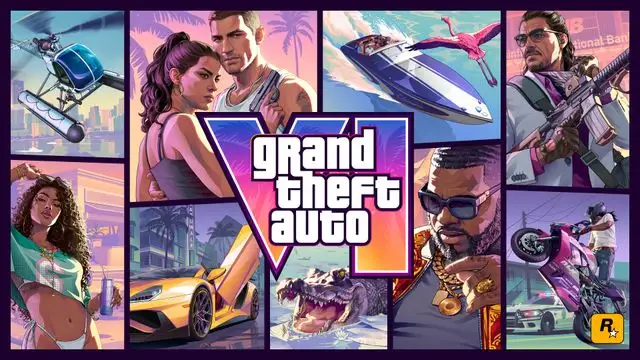
Grand Theft Auto 6 is set in a modern-day version of Vice City, Rockstar Games' fictional take on Miami, during the 2020s. The trailers showed an in-game social media platform baked into the world, influencer culture woven into the narrative, and a Florida setting that has spent the past decade becoming the most self-satirizing place on the planet. The game's biggest challenge is not the map size, the graphics, or the $3 billion budget. It is the jokes.
After all, how do you write satire about a world that is already more absurd than anything a writer's room could produce?
Game | Setting Era | Primary Satirical Targets | Why the Satire Worked |
|---|---|---|---|
GTA III (2001) | Late '90s / early 2000s | Crime films, urban decay, media panic about violence | Reality was still "normal"; exaggeration felt sharp |
GTA: Vice City (2002) | 1980s | Cocaine culture, excess, Miami Vice aesthetics | Historical distance made the satire nostalgic and affectionate |
GTA: San Andreas (2004) | Early '90s | Gang culture, police corruption, government conspiracies | Specific enough to be pointed, broad enough to be funny |
GTA IV (2008) | Mid-2000s | Immigration, the American Dream, post-9/11 paranoia | Darker tone matched the era; Niko's outsider perspective was the satirical lens |
GTA V (2013) | Early 2010s | Tech culture, reality TV, surveillance state, social media vanity | Pre-Trump, pre-TikTok, pre-AI; reality was absurd but still exaggerable |
GTA 6 (2026) | 2020s | Social media, influencer economy, Florida, political polarization, AI | Reality is already self-satirizing; exaggeration risks being indistinguishable from the news |
Each Grand Theft Auto targeted a cultural era and exaggerated it.
The last row is the problem. Every previous GTA could take reality and turn the dial to 11. GTA V's Lifeinvader was a parody of Facebook that felt exaggerated in 2013. In 2026, the actual Facebook has pivoted to the metaverse, laid off 20,000 employees, renamed itself Meta, and its CEO has started posting MMA training videos while wearing a gold chain. The parody version is less absurd than the real version, which is only one of the many examples of the satirical gap GTA 6 has to navigate.
GTA 6 guide
Grand Theft Auto VI: Everything We KnowRelease date, map, characters, gameplay and more, updated regularly.
The Florida setting makes this even worse. "Florida Man" is not a Grand Theft Auto joke. It is a real cultural phenomenon driven by Florida's public records laws, which make arrest reports accessible in ways that other states' laws do not, generating an endless stream of headlines that read like rejected GTA mission descriptions.
Rockstar's writers are competing with reality, and reality is not pulling its punches.
The social media part is the hardest to get right.
Footage from the first GTA 6 trailer featured an in-game social media platform where NPCs post selfies, record videos, and comment on the player's actions. In 2013, this would have been out of this world. In 2026? Not so much. These days, TikTok, one of the leading social media platforms, has 1.5 billion monthly active users, the influencer economy generates over $21 billion annually, and people have literally died filming content for social media engagement.
Political polarization is another landmine it has to navigate. Weazel News in Los Santos mocked Fox News. The in-game internet mocked both liberal and conservative extremism. The jokes landed because in 2013, most people could laugh at exaggerated versions of both sides. In 2026, any satirical stance on immigration, policing, gun culture, healthcare, or media bias will find itself interpreted through a hypersensitive lens that didn't even exist when the previous game shipped.
Today's volatile political environment has made neutral satire almost impossible, and taking a side risks turning the game into a culture-war flashpoint rather than cultural commentary.
GTA 6 giveaway
Win a full copy of GTA 6 Ultimate Edition.We're giving away full copies of GTA 6 Ultimate Edition in several draws through launch. Enter with your email, then join in once on the site. One entry per person.
Prize
A full copy of GTA 6 Ultimate Edition
Email first, then one site action during the draw window.
The good news is that Jason and Lucia, the two protagonists of GTA 6, offer something the franchise has never had: a character-driven satirical lens. Their Bonnie-and-Clyde dynamic is not about mocking America. It is about two people trying to survive in a system that is already a joke. The satire comes from their experience of the absurdity. GTA IV, a personal favorite of Rockstar co-founder Dan Houser, understood this better than GTA V did. Niko Bellic's outsider perspective made the satire land because the player experienced American dysfunction through the eyes of someone who found it genuinely bewildering.
Lucia, as a Latina woman navigating the criminal economy of modern Florida, has the potential to do the same thing. Her perspective on social media fame, on the gap between the Florida of tourist brochures and the Florida of day-to-day survival, on the American Dream as viewed from below rather than above, is inherently more interesting and more honest than broad institutional parody.
If Rockstar lets her perspective drive the satire rather than the writers' room, GTA 6 could produce the kind of comedy that reality cannot outpace because it is rooted in human experience rather than cultural exaggeration.
Ultimately, the smartest thing Rockstar could do is acknowledge that reality is already stranger than fiction and build the satire around that self-awareness. Let the characters notice that the world they live in is absurd. Let us see Lucia scroll through her in-game social media feed and react the way a real person would, with feelings of equal parts exhaustion, bewilderment, and the resigned humor of someone who has accepted that the news cycle is the joke.