

Few game franchises can claim to be as influential in the video game industry as Grand Theft Auto. The legendary and controversial series, which began in a small makeshift office in an attic, is turning 20 years old this month. So what better time than now to look back at such a long history?
One of the first interesting bits of trivia regarding GTA begins right at the very beginning — namely, no-one knows when it was exactly. At least, no one can back up claims with any kind of source. It is known that the very first GTA game was released in early October 1997, but which exact day in early October is not known.
A version of the first GTA game was released on the 12th of October that year, however that wasn't the initial version — it was a regional launch following the initial one, which logically happened sometime between the 1st and 11th of October. So for all we know, we've already passed the day of the 20th anniversary.
GTA didn't quite catch on though until the third game brought the franchise into the 3D age. However the most recent title, Grand Theft Auto V, gave the IP such an explosive boost in exposure and players that the majority of people who'd call themselves "GTA Fans" may very well only have played with 5, or played it first and then retroactively tried out older titles.
However, the international entertainment juggernaut that is GTA today, and Rockstar Games, the company behind it, were both very, very different at the beginning, and even before the beginning. While the first game was released in October 1997, the story of the IP begins earlier, and with a very different name.
In January 1995 a small game development company called DMA design, which would later morph into Rockstar Games through acquisitions and rebrandings, began planning a game which would use a unique pre-drawn graphics method, and would focus on top-down multiplayer racing with some combat mechanics.
Over time, this plan was refined and expanded in scope to include on-foot sections, and a greater focus on combat. This game was christened Race'n'Chase, and development officially began on the 4th of April, 1995 (funny, we know exactly when development began, but not when the game hit the shelves).
GTA's long history of controversy begins before it even bore the name Grand Theft Auto, as the development of Race'n'Chase was often threatened by higher-ups in the company worried about the depicted violence, and the developers reportedly had to "convince" superiors to allow the game to be finished and released several times. We're all extremely thankful today that they succeeded.
Eventually October 1997 rolled around and Race'n'Chase (now renamed Grand Theft Auto) was released to fairly positive reviews and moderate success. It wasn't an era-defining instant-classic (at the time, at least), but was praised for its fun gameplay, replayability, and it made enough cash to warrant expansions and a sequel.
Those expansions, which took the GTA gameplay to London, and were the first and only time the game took place in a country other than the USA and in a real city on top of it, were just more of the same with little by way of changes beyond the map itself.
Grand Theft Auto 2 is a rather odd duck about which you'll read more in our 2D Era retrospective next week, but in short, it took the franchise into a dystopian industrial sci-fi setting as opposed to the contemporary satirized realism the series became known for. This more abstract installment was a one-time deviation, as the next game would define the status quo of the franchise which we know today.
When Grand Theft Auto III rolled around in 2001, the winds of change were already blowing. DMA was still the developer, but Rockstar Games, not yet acquired by Take-Two, was the publisher, and a number of iconic franchise-defining staples were established. It may not be the most successful GTA game ever, but one could argue it was the most influential. It practically birthed a new genre.
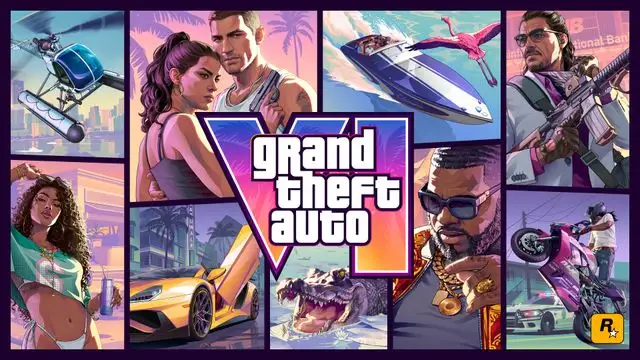
Some of the things GTA 3 introduced which stuck are the iconic collage cover art (which always has a helicopter in the top left corner), the fictional-but-obviously-based-on-a-real-location settings, the humor satirizing modern American society, the open world 3D gameplay, wide array of activities to complete and diverse lineup of memorable characters.
GTA 3 was also the first game in the franchise that could truly be called a massive success. For its time, the 2 million copies it sold in four months was a major achievement even if it pales to the sales of GTA 5 more than a decade later. Following this title, every single GTA game became a highly successful, top-selling title.
The 3D era is fondly remembered by fans of the franchise, yielding some of the series' most iconic locations such as Liberty City, Vice City and Los Santos. In name, Liberty City and Vice City appeared already, but these were their definitive incarnations until the arrival of the HD Era. Both spin-offs in the era, Vice City and San Andreas are considered to be among the best video games of all time, with some claiming each to be the best of the franchise to this day.
San Andreas stood out particularly with its large, multi-city map and relatable storyline and characters. It also took place roughly around the same time as GTA 3, and the two games were directly linked in terms of storyline. The 3D era also yielded some other spin-offs, namely the "-Stories" games which recycled the maps from 3 and Vice City to bring new storylines to different platforms.
When the HD era, begun by Grand Theft Auto IV, brought new depth and graphical fidelity to the franchise, another boost in popularity followed. Upon its release, the game broke several sales records and sold over 3.6 million copies within a day of launch, a stark contrast to GTA 3's two million over four months.
The game had the most detailed map in a GTA game to date, with the most activities and vehicles. It was a notable upgrade from previous titles in every technical aspect, though the story took a more somber and serious tone. Oh, the humor wasn't gone, what with internet cafés called TW@ and similar jokes, but the main storyline itself was darker than usual.
Many gameplay mechanics were extremely polished, however, and the game world was filled with easter eggs. Its success spawned two full-fledged expansions, The Lost and Damned and The Ballad of Gay Tony. These expansions used the base game's map, but introduced new characters, vehicles and game mechanics while expanding on the world and storyline of the main title.
GTA 6 giveaway
Win a full copy of GTA 6 Ultimate Edition.We're giving away full copies of GTA 6 Ultimate Edition in several draws through launch. Enter with your email, then join in once on the site. One entry per person.
Prize
A full copy of GTA 6 Ultimate Edition
Email first, then one site action during the draw window.
While not the first game in the franchise to have multiplayer, GTA 4's version of "Online" was popular and well received by players. It allowed up to 32 players to run around in the same world as in single player and to engage in various game-modes such as deathmatch, races and more, including a free play mode where they could just screw around in an unrestricted game world.
Additionally, server hosts could set a number of factors governing the multiplayer world, such as whether or not there would be police present, what weapons were available and the presence of NPCs. Many of these features are missing from the current iteration of GTA Online, much to the malcontent of fans.
Most recently, GTA 5 entered the lineup, and we've already written plenty about it in almost every aspect.
It broke every sales record there is, racked up over 80 million sales the last time we got a number, a long list of free DLC has been released for Online, and over the 4 years since its release, it racked up huge amounts of revenue, an immense player base and countless accolades and awards.
Over the next three weeks of October, we will take more detailed looks at the history of GTA, broken down into the three eras — 2D, 3D and HD. We'll be starting with a more in-depth look at the series's beginnings, and the odd title that was GTA 2 next week.
Over two decades, Grand Theft Auto has amassed a staggering number of fans. Some have been following the franchise since day one, some dropped out, while others only came into the fold later in the series, but all of them share some fond memories spent in the virtual worlds created by DMA and Rockstar.


